One of the most valuable things about partitioned tables is pruning - the database's ability to eliminate entire partitions based on a query predicate. Under conventional wisdom, pruning can only be achieved when querying by the partition key - this makes choosing the right key extremely difficult. However, if your data follows certain patterns, using some clever tricks you can achieve pruning even when filtering by non-partition key columns.
In this article, I demonstrate how to achieve partition pruning when filtering by non-partition key columns.

Table of Contents
Table Partition
Imagine you run a popular website with many users. Your product team wants to gain some insight into how the system is used, so you start logging events. To give events context, you group them into sessions and keep the time, the type, and some data in a database table:
db=# CREATE TABLE event (
  id         BIGINT GENERATED ALWAYS AS IDENTITY,
  timestamp  TIMESTAMPTZ NOT NULL,
  session_id BIGINT NOT NULL,
  type       TEXT NOT NULL,
  data       JSONB
) PARTITION BY RANGE (timestamp);

CREATE TABLE;
You have many users so you expect many events. Most queries use only a subset of the data, usually a specific date range, so you create a partition for each year based on the timestamp:
db=# CREATE TABLE event_y2025 PARTITION OF event
FOR VALUES FROM ('2025-01-01 UTC') TO ('2026-01-01 UTC');

CREATE TABLE

db=# CREATE TABLE event_y2026 PARTITION OF event
FOR VALUES FROM ('2026-01-01 UTC') TO ('2027-01-01 UTC');

CREATE TABLE
You now have two partitions - one for events from 2025 and another for 2026. A session can look like this:
INSERT INTO event (session_id, timestamp, type, data) VALUES
  (1, '2025-12-28 15:00:00 UTC', 'view',         '{"page": "/login"}'),
  (1, '2025-12-28 15:00:06 UTC', 'click',        '{"selector": "#login"}'),
  (1, '2025-12-28 15:00:07 UTC', 'login_failed', '{"attempt": 1}'),
  (1, '2025-12-28 15:00:10 UTC', 'click',        '{"selector": "#forgot-password"}'),
  (1, '2025-12-28 15:00:17 UTC', 'view',         '{"page": "/reset-password"}'),
  (1, '2025-12-28 15:00:23 UTC', 'click',        '{"selector": "#reset-password"}');
In this session the user tried to log into the system, failed and asked to reset their password.
To make the examples more realistic we need more data, so let's create some:
WITH
sessions AS (
  SELECT
    n AS session_id,
    '2025-12-28 23:59:56 UTC'::timestamptz + interval '1 minute' * n as started_at
  FROM
    generate_series(2, 10_000) AS t(n)
)
INSERT INTO event (session_id, timestamp, type, data)
SELECT
  session_id,
  started_at + interval '1 second' * n,
  (array['view', 'click', 'login_failed', 'logged_in'])[ceil(random() * 3)] as type,
  '{}'::jsonb as data
FROM
  sessions,
  generate_series(1, 5) as n
ORDER BY 1, 2;

INSERT 0 49995
You now have ~50K events in the table across both partitions.
Partition Pruning for Key Columns
The partition key of the table is timestamp, so queries that filter by timestamp can benefit from partition pruning. For example, query events in December 2025:
db=# EXPLAIN SELECT * FROM event
WHERE timestamp >= '2025-12-01 UTC' AND timestamp < '2026-01-01 UTC';
                            QUERY PLAN
────────────────────────────────────────────────────────────────────────────────────────────────
 Seq Scan on event_y2025 event
   Filter: (("timestamp" >= '2025-12-01 00:00:00+00'::timestamp with time zone)
           AND ("timestamp" < '2026-01-01 00:00:00+00'::timestamp with time zone))
Notice that the database was smart enough to figure out it only needs to scan the partition for 2025. The partition for 2026 was not even accessed. This is partition pruning.
Another common query is to find all events for a given session:
db=# EXPLAIN SELECT * FROM event WHERE session_id = 1;
                 QUERY PLAN
──────────────────────────────────────────────────────
 Append  (cost=0.00..1060.07 rows=11 width=37)
   ->  Seq Scan on event_y2025 event_1
         Filter: (session_id = 1)
   ->  Seq Scan on event_y2026 event_2
         Filter: (session_id = 1)
This time, the database accessed all partitions - partition pruning was not used. In this query, the database has no way of eliminating partitions, so it had no other choice but to scan all partitions to look for matching events.
This is where partitions get a bit hairy. On one hand, you want to achieve pruning, but then you have to make painful compromises in other, potentially very common queries.
Local Indexes
Getting events for a specific session is fairly common, so it needs to be fast. To make things fast in databases you should just create an index, right?
db=# CREATE INDEX event_session_ix ON event(session_id);
CREATE INDEX
This creates an index on the session ID. With the index in place, get events for session 1:
db=# EXPLAIN SELECT * FROM event WHERE session_id = 1;
                          QUERY PLAN
─────────────────────────────────────────────────────────────────────────
 Append  (cost=0.29..16.82 rows=11 width=37)
   ->  Index Scan using event_y2025_session_id_idx on event_y2025 event_1
         Index Cond: (session_id = 1)
   ->  Index Scan using event_y2026_session_id_idx on event_y2026 event_2
         Index Cond: (session_id = 1)
The database once again had to visit all partitions. The only difference is that this time, it used the index on each partition.
Using an index is faster than scanning the entire partition, but the database is still forced to scan through all of the partitions. Right now there are only two partitions, but if the table had a hundred partitions, this query would be like querying a hundred tables!
This type of index is called a local index because it creates a separate index on every partition:
db=# \di event_*
                                List of indexes
 Schema │            Name            │       Type        │ Owner │    Table
────────┼────────────────────────────┼───────────────────┼───────┼─────────────
 public │ event_session_ix           │ partitioned index │ haki  │ event
 public │ event_y2025_session_id_idx │ index             │ haki  │ event_y2025
 public │ event_y2026_session_id_idx │ index             │ haki  │ event_y2026
Local indexes are useful when you frequently filter by columns not part of the partition key.
Global Indexes
Another approach to indexing partitioned tables is to create a single index that spans multiple partitions. This is called a global index.
Unfortunately, as of version 19, PostgreSQL does not support global indexes on partitioned tables. You can keep an eye on the pgsql-hackers mailing list for updates, there are discussions going all the way back to 2009 on this subject.
Global Index
Another pain point of not having global indexes is that it makes it difficult to enforce uniqueness on anything other than the partition key. This is outside the scope of this article.
Pruning on Non-Partition Key Columns
The events table is partitioned by timestamp, so queries by timestamp can benefit from partition pruning. However, there are still many situations where you want to query by session ID. Events from a single session can potentially span multiple partitions and the database currently has no way of eliminating irrelevant ones. Local indexes alleviate some of the pain, but the database still has to visit all partitions, which may not scale very well.
At this point you reached the limit of what the database can just do out of the box, and you need to tap into your domain expertise and knowledge of the data - how it's being used and how it's being stored:
- The events table is append only: no updates to the table, events are immutable.
- Session IDs are generated sequentially: session IDs increment over time.
- Sessions are short lived: a normal session is usually no longer than a couple of minutes or hours.
This pattern can be useful!
To visualize the pattern, plot the timestamp against the session ID:
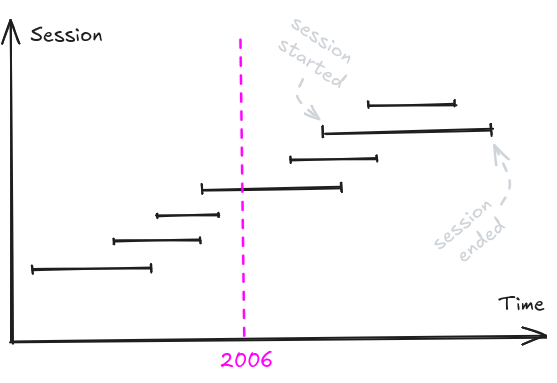
Session ID is strongly correlated with the timestamp. This means it should be possible to identify a distinct range of session IDs for each partition.
Get the first and last session ID in each partition:
db=# SELECT tableoid::regclass, MIN(session_id), MAX(session_id)
FROM event GROUP BY 1 ORDER BY 1;
  tableoid   │ min  │  max
─────────────┼──────┼───────
 event_y2025 │    1 │  4320
 event_y2026 │ 4320 │ 10000
Thanks to the strong correlation between the session ID and the timestamp, you can identify a clear and distinct range of session IDs for each partition. Just by looking at the results, it's clear that sessions with IDs between 1 and 4319 only exist in the 2025 partition, and sessions with IDs between 4321 and 10000 only exist in the 2026 partition.
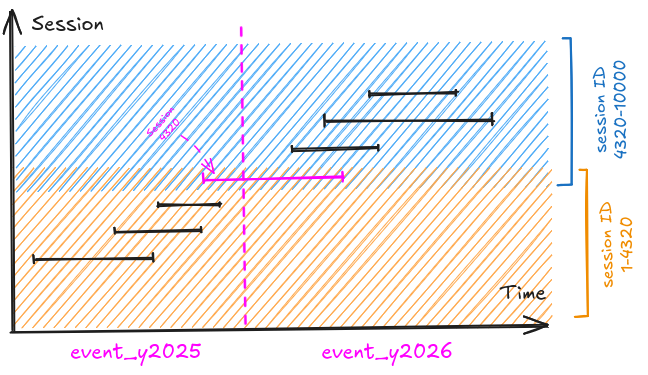
Knowing this pattern, the database can potentially eliminate entire partitions when querying by the session ID, but how can you communicate this information to the database?
Talking to the Optimizer
The database optimizer is truly a marvelous piece of engineering. It takes a query and figures out on its own how to execute it without looking at the actual data. The only thing the database can use, are statistics it maintains on tables and columns.
Statistics are used to produce row estimates. Row estimates help the optimizer decide which tables to scan first, which indexes to use and what filters or joins to apply and in what order. However, as the name suggests, statistics are just statistics - there is no guarantee they are correct, so the optimizer can consult them, but never blindly rely on them.
The only information the optimizer can rely on, is information that is guaranteed to always be correct. In databases, to guarantee that something is always correct, you use a constraint.
Check constraints are used to enforce custom validation rules. Using a check constraint, you provide an expression and the database guarantees that the expression is true for all the rows in the table. But here's the secret, the thing nobody tells you about - check constraints can be used to communicate information about your data to the optimizer.
For example, if you have a check constraint to make sure event ID is always greater than zero, if you query for events with ID less than zero, the database doesn't really have to scan the table to figure out no rows can match this condition, right?
To check if you can influence the optimizer, add a simple check constraint on each partition to enforce a specific range of session IDs:
db=# ALTER TABLE event_y2025 ADD CONSTRAINT event_y2025_session_id_range
  CHECK (session_id between 1 and 4320);
ALTER TABLE

db=# ALTER TABLE event_y2026 ADD CONSTRAINT event_y2026_session_id_range
  CHECK (session_id between 4320 and 10000);
ALTER TABLE
The first check constraint sets the range for the 2025 partition to session IDs between 1 and 4320. The second check constraint sets the range for the 2026 partition to session IDs between 4320 and 10000.
Now to see if the database can actually use the check constraint to eliminate entire partitions, query events for session with ID 1000:
db=# EXPLAIN SELECT * FROM event WHERE session_id = 1000;
                  QUERY PLAN
──────────────────────────────────────────────────────────────────
 Index Scan using event_y2025_session_id_idx on event_y2025 event
   Index Cond: (session_id = 1000)
Amazing! With the check constraint in place, the database was able to eliminate the partition for 2026. According to the constraint, this partition can only contain session IDs between 4320 and 10000 and the query looks for session ID 1000. The database ended up scanning only one partition.
Check another session ID:
db=# EXPLAIN SELECT * FROM event WHERE session_id = 6000;
                  QUERY PLAN
──────────────────────────────────────────────────────────────────
 Index Scan using event_y2026_session_id_idx on event_y2026 event
   Index Cond: (session_id = 6000)
Once again, the database scanned only a single partition. This time, according to the check constraint, events for session ID 6000 can only be in the partition for year 2026, so the database only scanned that partition.
What if you query for a session that may have events in more than one partition?
db=# EXPLAIN SELECT * FROM event WHERE session_id = 4320;
                       QUERY PLAN
─────────────────────────────────────────────────────────────────────────
 Append  (cost=0.29..16.80 rows=10 width=37)
   ->  Index Scan using event_y2025_session_id_idx on event_y2025 event_1
         Index Cond: (session_id = 4320)
   ->  Index Scan using event_y2026_session_id_idx on event_y2026 event_2
         Index Cond: (session_id = 4320)
The database scanned two partitions and that's OK! Based on the check constraints, both of these partitions may have events for session ID 4320.
This demonstrates that using carefully crafted check constraints you can communicate information about your data to the database, and the database can use that information to eliminate entire partitions and effectively achieve partition pruning.
The constraint_exclusion Parameter
This pruning mechanism is controlled by the parameter constraint_exclusion:
Controls the query planner's use of table constraints to optimize queries. [...] When this parameter allows it for a particular table, the planner compares query conditions with the table's CHECK constraints, and omits scanning tables for which the conditions contradict the constraints.
Constraint exclusion is on by default for partitioned tables. The database will use any check constraint you have on a partitioned table to achieve pruning, and you don't even have to change any parameters for it.
I wrote about using constraint_exclusion on a non-partitioned table to eliminate entire table scans in queries that contain impossible predicates.
Introducing Outliers
To achieve pruning for queries by session ID you relied on the predictable nature of the data and the strong correlation between the session ID and the timestamp. In this case, the table is append only and sessions are short lived. This means there's not a lot of overlapping session IDs between partitions, and it's possible to identify distinct ranges for each partition.
Unfortunately, reality is usually not that tidy! What if some sessions become days or weeks long? This can introduce outliers into the ranges.
First, drop the check constraints so you can introduce outliers:
db=# ALTER TABLE event_y2025 DROP CONSTRAINT event_y2025_session_id_range;
ALTER TABLE

db=# ALTER TABLE event_y2026 DROP CONSTRAINT event_y2026_session_id_range;
ALTER TABLE
Now, consider this session:
db=# SELECT * FROM event WHERE session_id = 1 ORDER BY timestamp;
  id │       timestamp        │ session_id │     type     │               data
─────┼────────────────────────┼────────────┼──────────────┼──────────────────────────────────
  1  │ 2025-12-29 15:00:00+00 │          1 │ view         │ {"page": "/login"}
  2  │ 2025-12-29 15:00:06+00 │          1 │ click        │ {"selector": "#login"}
  3  │ 2025-12-29 15:00:07+00 │          1 │ login_failed │ {"attempt": 1}
  4  │ 2025-12-29 15:00:10+00 │          1 │ click        │ {"selector": "#forgot-password"}
  5  │ 2025-12-29 15:00:17+00 │          1 │ view         │ {"page": "/reset-password"}
  6  │ 2025-12-29 15:00:23+00 │          1 │ click        │ {"selector": "#reset-password"}
The user started their session on December 29, 2025. They attempted to log in, failed, and asked to reset the password. Imagine this user left their tab open, came back a few days later and decided to finish the process:
INSERT INTO event (session_id, timestamp, type, data)
values
  (1, '2026-01-01 12:01:14 UTC', 'click', '{"selector": "#reset-password"}'),
  (1, '2026-01-01 12:01:15 UTC', 'view',  '{"page": "/login"}');

INSERT 0 2
These events caused a session with a very low ID to be added to a recent partition. This partition currently contains session IDs with much higher values. This affects the session ID range in the first partition:
db=# SELECT tableoid::regclass, MIN(session_id), MAX(session_id)
FROM event GROUP BY 1 ORDER BY 1;

  tableoid   │ min │  max
─────────────┼─────┼───────
 event_y2025 │   1 │  4320
 event_y2026 │   1 │ 10000
The range for the first partition just became useless! If you create check constraints based on these ranges, any session ID between 1 and 4320 will hit both the 2025 and the 2026 partitions.
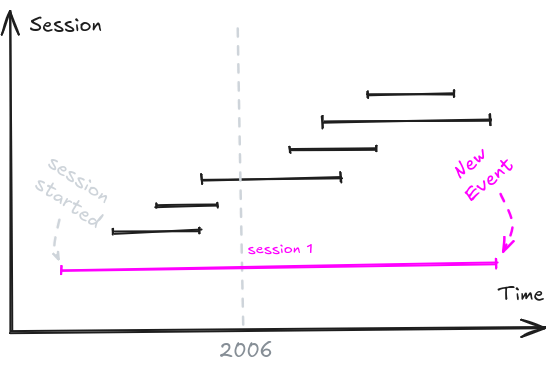
To tackle this problem, we can draw some inspiration from PostgreSQL itself!
Handling Outliers
PostgreSQL includes a Block Range Index (BRIN) that works on a range of adjacent pages on disk. The default operator for indexing a range of adjacent pages is minmax. This operator works by keeping the minimum and the maximum value for each range - very similar to what we did for each partition. The minmax operator also relies on good correlation and suffers when the data contains outliers.
To address the challenge of outliers in BRIN indexes, in PostgreSQL 14 a new operator was introduced - the multi-minmax operator. This operator keeps multiple min-max ranges instead of just one! This means outliers are contained and don't compromise the effectiveness of the entire index.
Inspired by the multi-minmax BRIN index operator, adjust the check constraint to use multiple ranges:
db=# ALTER TABLE event_y2025 ADD CONSTRAINT event_y2025_session_id_range
  CHECK (session_id BETWEEN 1 AND 4320);
ALTER TABLE

db=# ALTER TABLE event_y2026 ADD CONSTRAINT event_y2026_session_id_range
  CHECK (session_id BETWEEN 1 AND 1 OR session_id BETWEEN 4320 AND 10000);
ALTER TABLE
Notice the check constraint for 2026 now includes two ranges - one for [1, 1], and another for [4320, 10000]. This means values between 2 and 4320 will no longer have to query the second partition.
Let's see if PostgreSQL is smart enough to use this condition for pruning:
db=# EXPLAIN SELECT * FROM event WHERE session_id = 1000;
                    QUERY PLAN
───────────────────────────────────────────────────────────────────
 Index Scan using event_y2025_session_id_idx on event_y2025 event
   Index Cond: (session_id = 1000)

db=# EXPLAIN SELECT * FROM event WHERE session_id = 6000;
                    QUERY PLAN
───────────────────────────────────────────────────────────────────
 Index Scan using event_y2026_session_id_idx on event_y2026 event
   Index Cond: (session_id = 6000)
It is! In both cases the database scanned just one partition.
What about the outlier session ID?
db=# EXPLAIN SELECT * FROM event WHERE session_id = 1;
                    QUERY PLAN
─────────────────────────────────────────────────────────────────────────
 Append  (cost=0.29..16.80 rows=10 width=37)
   ->  Index Scan using event_y2025_session_id_idx on event_y2025 event_1
         Index Cond: (session_id = 1)
   ->  Index Scan using event_y2026_session_id_idx on event_y2026 event_2
         Index Cond: (session_id = 1)
As expected, PostgreSQL correctly identified based on the constraint that session 1 can be in two partitions, and scanned both of them.
The logic to prove logical implications between predicate expressions is implemented in master/src/backend/optimizer/util/predtest.c.
Gaps and Islands
So far you achieved pruning on non-partition key columns and created a mechanism to handle potential outliers. The only thing left is to identify the ranges, a classic "gaps and islands" problem.
Finding ranges of consecutive session IDs not exceeding 1 in the 2026 partition:
db=# WITH
detection AS (
  SELECT session_id, session_id - lag(session_id) OVER (ORDER BY session_id) > 1 AS is_gap FROM event_y2026
), gaps AS (
  SELECT session_id, sum(is_gap::int) OVER (ORDER BY session_id) AS gap FROM detection
)
SELECT MIN(session_id) mn, MAX(session_id) mx FROM gaps GROUP BY gap;

  mn  │  mx
──────┼───────
    1 │     1
 4320 │ 10000
These are the ranges to use in the check constraint.
To take it further, parameterize the query and have it generate the command to create the check constraint:
\set gap 1
\set partition_name event_y2026

WITH
detection AS (
  SELECT session_id, session_id - lag(session_id) OVER (ORDER BY session_id) > :gap AS is_gap FROM :partition_name
), gaps AS (
  SELECT session_id, sum(is_gap::int) OVER (ORDER BY session_id) AS gap FROM detection
), ranges AS (
  SELECT MIN(session_id) mn, MAX(session_id) mx FROM gaps GROUP BY gap
)
SELECT
  'ALTER TABLE ' || :'partition_name' || ' ADD CONSTRAINT ' || :'partition_name' || '_session_id_ranges CHECK ('
  || array_to_string(array_agg('session_id BETWEEN ' || mn || ' AND ' || mx), ' OR ')
  || ');' AS command
FROM ranges;
                                                                    command
───────────────────────────────────────────────────────────────────────────────────────────────────────────────────────────────────────────────
 ALTER TABLE event_y2026 ADD CONSTRAINT event_y2026_session_id_ranges CHECK (session_id BETWEEN 1 AND 1 OR session_id BETWEEN 4320 AND 10000);
Awesome! If you're feeling confident, go ahead and add \gexec in the end there...
The Backstory
Earlier this year I attended Django Con EU in Athens to give a talk about Reliable Signals in Django. In one of the other talks, the speaker presented their approach to partitioning large tables with Django and PostgreSQL. The talk was overall very good, but what I found most interesting was how they used check constraints to achieve pruning when querying a big partitioned workflows tables by non-partition key columns.
I knew the speaker from a previous Django Con in Dublin when he challenged me on stage during the Q&A for my talk about foreign keys. I also published an article about constraint exclusion just a few months prior to the talk, so I went to talk to him.
The speaker mentioned reading my article on constraint exclusion and we started discussing their approach. I was mostly interested in how they handle outliers. At the time, they haven't solidified their approach to outliers yet, so inspired by the multi-minmax brin operation, I suggested using a check constraint on a multirange type.
When I came back from the conference I started experimenting. I quickly found that multirange types don't work for pruning. I wasn't ready to give up, so exploring a bit further led me to try multiple simple conditions joined with an OR, and this article was born.
Final Thoughts
Choosing the right partition key is very challenging. One of the reasons it is so difficult is that the partition key is used for pruning, and unless all queries are using it, you need to make a compromise.
Using constraint exclusion on non-partition key columns opens up a whole new way to gain pruning. If your data follows a predictable pattern and there's a certain point after which the data dosen't change any more, the compromise isn't so bad and deciding on a partition key becomes a bit easier.